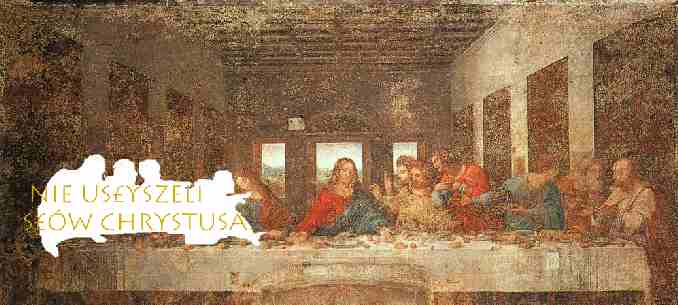
My attempt to investigate and prove, that’s possible requires a return to the beginnings of Leonardo’s painting in Dominican friars refectory in Milan (1494/1495). It is also the beginning of spiritual dictatorship of Dominican friar Savonarola and times of the “new deluge” how he named the French invasion of Italy from the year 1494. At the same age as Leonardo, before was burnt at the stake in Florence (1498), he accurately predicted the near Medici ending, calling for asceticism of the monastic life and the widespread penance.
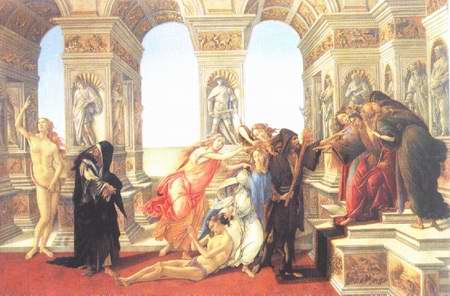
The Announce about brutal capturing the prior of the St Mark monastery (of the Florentine Dominican friars), equally fast spread all over cities of Italy, as words of papal excommunication kept on being repeated from pulpits since May 13th in 1497, thrown on monk by Alexander The 6th Borgia. If Botticelli – Florentine friend of Leonardo, has finished also in same time, (of what unfortunately we cannot be certain) painting his famous “Slander” far more easily it is possible to see in it, the synthetic record of the life and the macabre death of Savonarola.
He introduced the Stupidity there on the throne on one site of the stage, but the Penance and the naked Truth pointing at the heaven, after opposed. He left the center for title Slander, who with one hand is pulling his victim’s hair, in second keeping the torch being on fire – been good although differently interpreted allegorical image of the historical moment of Florence, written with the language of gesture. Hic Botticelli’s sharp and clever form of description of the present day, with very safe (for him) ancient scenery. In general it is being accepted that Botticelli uses the ancient theme here from the painter Apelles’s life (4th / 3rd century BC) – at the court of: Alexander the Great, then Ptolemy(?), at least that obvious, as the theme of earlier “Spring”. That one however – according to A. Warburg – with possible suggestions of humanists of the manor Medici house, above all Angelo Poliziano.
Once both, he and probably Marsilio Ficino, whereas perhaps the keenest of Savonarola’s adherents, admonished already earlier by the Church – heretic, philosopher, philologist and the prince in one Pico della Mirandola – wanted the conversation or at least a meeting with the monk, arriving to his sermons, even the ones out of Florence.
In 1494 manor the Medici house is leaving the town. In same 1494 year passes away: A. Poliziano and Pico della Mirandola (both even buried in Dominican habits) so they also haven’t been seeing, how Florence under the leadership of Girolamo Savonarola becomes involved in the period of republican governments.
From those three of humanists, it was Marsilio Ficino who over passed the Savonarola’s death (for the one year). He also, admittedly already after his death, named him the Antichrist. Beside Botticelli’s “Slander” whether for example “The punishment of Kore” a particularly clear example of the allusiveness of themes of that time paintings, as historians assert (Peter Burke for example) – are murals Rafael painted for popes (Julius The 2nd and Leon The 10th) – “Heliodor expelled from the Temple” and “Repulsing Attila the Hun”, where elaborated political allegories were understood well and without obstacles by strictly determined circles of recipients (the papal manor house and its surroundings ).
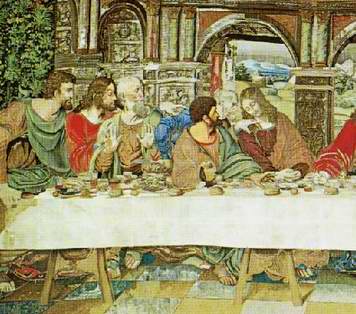
Not out of sync happens here with the Leonardo’s one. Same speaking with gestures and symbols reaches the straight and evocative language of his narrative painting and this time is directed towards a narrow circle of Dominican monks – the preachers.
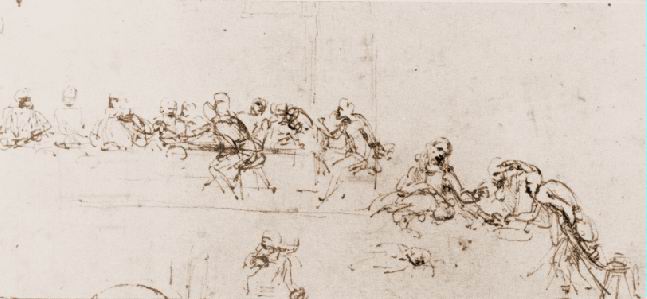
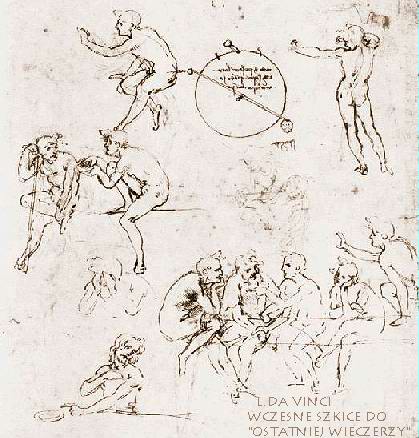
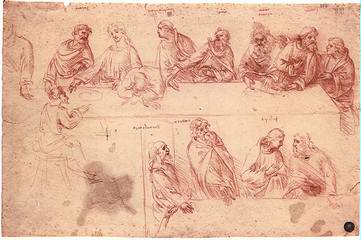
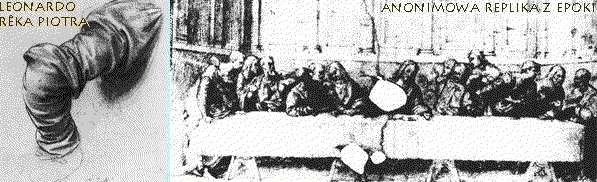
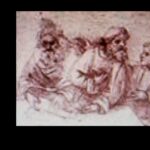
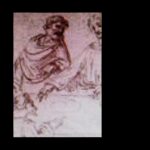
Since it’s well established, that the secret of the Holy Mystery Leonardo concluded in the person of Christ (Vasari), I would add – only in the person of Christ, leaving it unfinished, the way he presented apostles in the “Last Supper”, can be legible as the sequence of ideograms – the impressing effect of his studies for the human physiognomy, humane behaviors, and this time even for gestures of the hands.
It is not expelled that, this precise language of gestures is leading into very concrete Gospel. I mean concrete, because at every of Evangelists, the word of the Christ is being quoted differently during the Last Supper and differently described reaction of Judas.
However only at St Mark’s, Christ isn’t joining in the conversation with Judas, confining himself to the gesture. I would lean towards the thesis, that only this one among four Gospels (found inspired by the Church) was the source of Leonardo’s inspiration. St Mark’s Gospel as the only, held in the simple form of relation of the observer, offers in place of sophisticated interpretations of Christ’s lessons at remained authors, the information about acts of the Christ, that is descriptions of moments with his presence, suggesting the sequence of answering events on the mural straightest in the Milan monastery.
So if to verbalize it using quotations, I would rather suggest St Mark’s ones to be present in commentaries on Leonardo’s “Last Supper” instead of less matching content of the rest of them to that particular scene.
However before the next time we’ll take a look at the mural, let us try to consider a few evidences which could play a role in changes, Leonardo made in it. Where from appears the idea of different one than strengthened with painting tradition, of richer form of portraying the Last Supper? Whether topic of debates apart from traditional Collationes, during common meals with Dominican friars (in their refectory), could be also undergone current events at St Mark’s monastery from yet closely Leonardo Florence? They concerned sermons of one of co-brothers of the order of preachers after all.
So far for each of brothers of the convent, whenever a new mission demanded it, a dispensation from everyday monastic duties was being given, with purpose of solid studies for such a preacher, before a next challenge on the road full of struggle with the Reformation and at the same time for reinforcing the authority of the papacy. Above all the emphasis on research was placed, therefore the Dominican monastery more resembled the prestigious college and thanks to the ones most able co-brothers, reached for the leading place in Roman Catholic philosophy – just to recall here only St Thomas of Aquin.
“So far”, because the monk Hieronymus with an unprecedented courage incited to rebel, criticizing and threaten secular mighty including the emperor, as well as the Church together with the pope alone. Stigmatizing the lasciviousness and the splendor of the papal manor house (mostly weakness for women), pointed at cardinals and a spicy hero – Pope Alexander, exposing his ridicule stories with women, who according to chronicles: “worked on him more strongly than the magnet to iron.”
Indisputable influence of sermons of the Dominican friar Savonarola, for example on Michelangelo, Fra Bartolommeo or Botticelli and his late paintings, has no distinct counterparts at Leonardo’s. So independent and open minded, consumed with long-standing works at Dominican’s however,
could far more closely keep an eye on the text of the Gospels and especially the historical side of the origins of Christianity, which nowhere else but here was put equally with the Roman state religion (so-called Milan edict of Constantin in 313).
Getting started his magnificent painting he knew well about the scale, every oncoming pope entrusted with for this elite order. Domini canes – how they were christened, that is “dogs of the Lord”, they used to track smallest even signs of heresy (the order of Jesuits comes into existence only in 1534). Preaching specialists with the feature of religious authenticity leaned against the solid scientific foundation. That’s proximately, how we could determine the ambitious program of priestly bond Dominic Guzman, living according to modified by him Rules of St Augustine who also here in Milan, accepted Christianity from hands of St Ambrose – bishop and later patron of the city.
It is during his episcopate, when three early Christian basilicae appeared and the unique, octagonal baptistery – all at the end of fourth century. A worship of martyrs is growing stronger and their remains as holy relics, here for the first time are being deposited (against the Roman law) beneath altars of built temples: of St Apostles, St Martyrs and other churches. That special, centenarian period ended with fall of the Rome in the last quarter of the 5th century, doesn’t possess its cards of history. The last Roman historian of these times – Ammianus Marcellinus finishes his description on defeat of Valens legions under Adrianople. Alike, for him contemporary St Hieronymus finished the “Chronicle” on same 378 year.
Admittedly Milan, capital city abounding with early Christian traditions of the Western Empire, with residences of the first Christian emperors had survived descents of barbarians (Ostrogoths, Arian Vizigoths, and the like) and considerable number of internal conflicts, however many years later, in year 1162 armies of Frederic Barbarossa entirely destroyed that ancient Milan. Earlier, well in year 1075 the church of St Apostles burnt down then had been rebuilt, preserving the original plan (as many other buildings), but the relics of apostles: John, Andrew and Tomas were lost for a few hundred years, found by chance, already after Leonardo times, during the changing of place for the altar. Intact however, lasted in the basilica of St Mark in Venice as the part probably the same gift of the bishop of Rome, Damasus for the bishop St Ambrose (later patron of Milan).
About the fact that Constantine’s basilicae interested much Leonardo we know from the fact of leading by him measuring works of the basilica St Paolo Fuori le Mura in Rome – analogous in terms of its foundations to Milan Ambrosiana (with the St Ambrose grave). Another Constantine’s basilica of Rome – St Peter’s, was then demolished and rebuilt by the Leonardo’s friend from Milan years, Donato Bramante, soon after whom, his relative Rafael took over the inheritance.
Constant wars, in which wonderful cities-states of Italy once gaining and then lose the independence among their ruins, still last in times of Leonardo, but in the very unusual way seem not to concern neighboring Venice. Everything here is different from the rest of Italian cities. Venice owed Byzantium the current peace on her borders, in the end developing the stable political system. Gradually expanding the fleet, took control over the entire trade with the East still in the 11th century to become an indisputable naval power. Venice as the one from first, in response to papal calls, had an opportunity and had organized crusades to the Holy Land – been variously with that, but simultaneously aspiring to the name of the true defender of the faith. Finally it is mainly Venice as part of the Lombardy league, she helped to rebuild Milan destroyed by imperial army in mentioned 1162 year.
Such a history, until now favorable to Venice, entailed also with the exceptional situating of a town, could know Leonardo just therefore a lot. It would be unwisely to assume that he wasn’t much interested in a city which safely unreeled without its curtain walls. From c. eighth century incessantly, St Mark’s relics are deposed in Venice – religious Venetians sneak out saint’s remains all the way from Alexandria.
According to a tale, survived before burned down thanks to a violent downpour which extinguished the burning pile log with the body of the martyr.
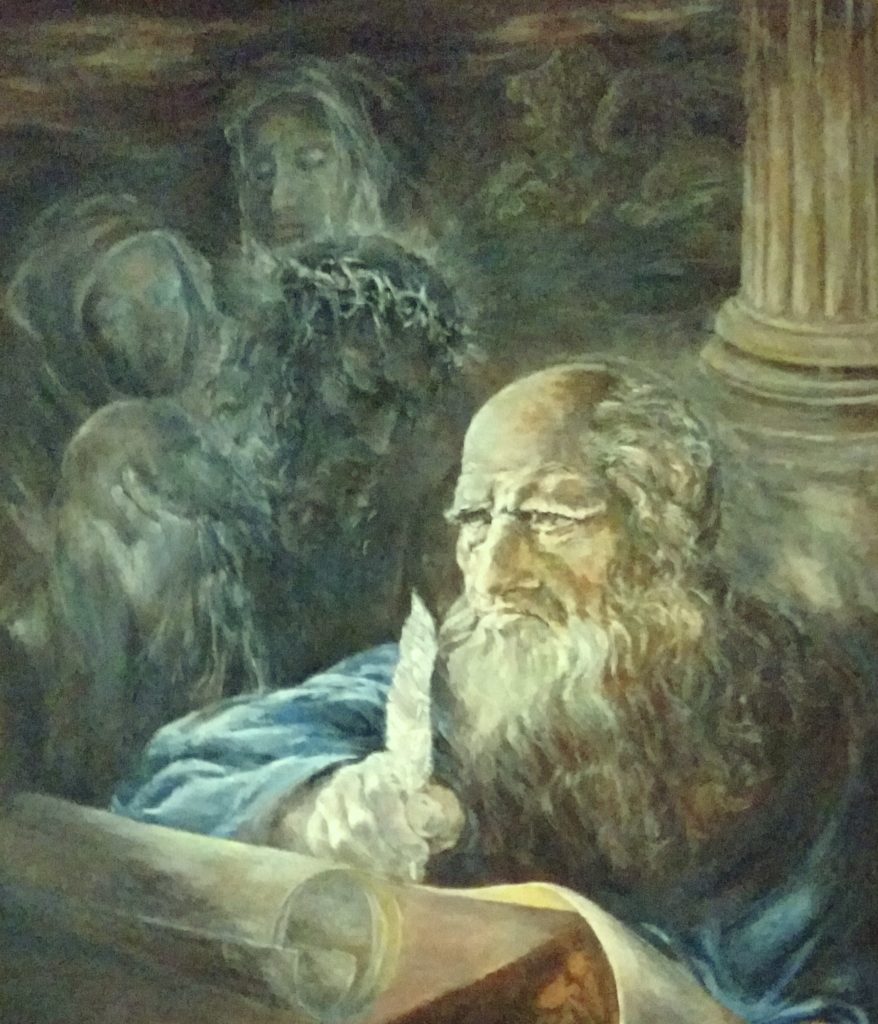
This legend Leonardo certainly knew, and recent martyr’s death of the Dominican friar on the stack in Florence not only evoked it for the Master, appearing the less interesting face of the Church, but certainly even more confirmed him in the belief in always possible – less tactful forms of its “rhetoric”, here fought just with the uncomfortable truth, propagated by the troublesome monk who at the end finishes his life on the stack (like some time Mark Evangelist).
In Venice magnificent Basilica of St Mark as the reliquary for holy remains of the patron of the city, built in first half of the 9th c. after over two hundred years rebuilt, to fit the form of St Apostles church – the biggest (after Hagia Sophia) of the Constantinople churches, demolished after its fall (1453). For its incessantly lasting beauty, it made bashful and pulled every pilgrim who reached the St Mark square to participate in the prayer and mass by relics of the martyr.
For Leonardo, as well as for all Italians of the 15th and 16th century, equally essential for urban life celebrations was a kind of public performances, played for gracing the patrons of religious cities. The one from most wonderful used to happen here, in Venice commemorating St Mark (in Milan – St Ambrose, in Florence – St John the Baptist, etc.). Nota bene, the oldest fragment which survived to this day belongs to the Gospel of St Mark. If today we are more inclined to make changes in the accepted sequence of three first Gospels, that’s also the reason (according to research
Footnote 13 provided at the end of the 20th c., which dates St Mark Gospel back to Qumran destroyed by Romans in 68 after Christ) and allocates it in, so-called eyewitnesses period – that is events which for all Christians impersonate source of their faith. Consciously or not, but in accordance with the Dominican arsenal of theological argumentation, Leonardo dates back to the first-hand account. And so let us go back to the Milan refectory and let us look one more time at the “Last Supper”.